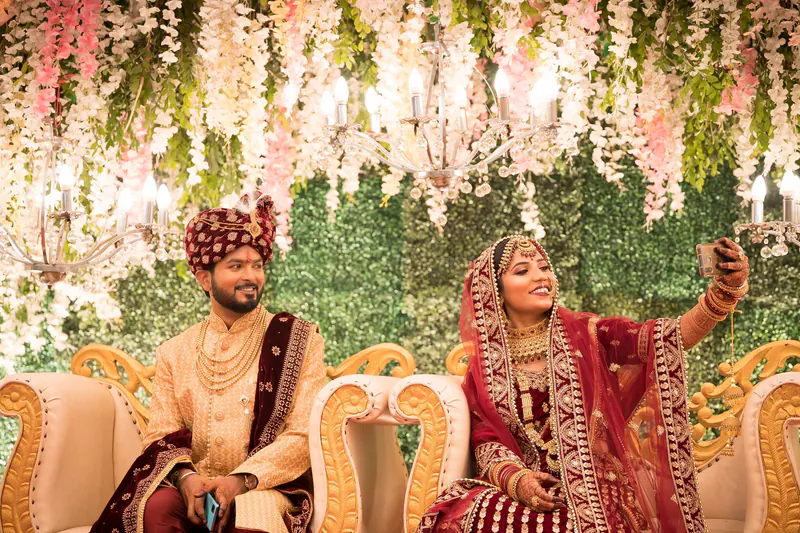
The Baniya community, encompassing Vaishya families across north India, traditionally engaged in trade, money-lending, and commerce, has built much of India's mercantile economy over many centuries. Spread across Rajasthan, Haryana, UP, Madhya Pradesh, Bihar, Gujarat, and increasingly all metros, Baniya families operate everything from neighborhood kirana stores to multi-thousand-crore listed businesses.
Baniya matrimony has its own logic, distinct from the closely-related Marwari and Aggarwal communities.
For Baniya families starting the search, for anyone serving them, and for candidates trying to understand the cultural expectations they're navigating.
The Baniya umbrella
"Baniya" is a broad term covering many distinct sub-communities. Important distinctions:
- Maheshwari, Agrawal, Oswal, Khandelwal, Saraswat, Vaishya, Marwari-origin Baniyas, mostly Rajasthan-Mumbai axis
- Aggarwal, north Indian (Delhi-Haryana-Punjab) Baniya, distinct from Marwari Agrawal
- Gupta, UP/Bihar/MP Baniyas, often distinct sub-communities
- Jain (Digambara, Shvetambara), religiously distinct, though often considered within the broader Baniya/Vaishya umbrella
- Vaish, generic term in some regions
- Khatri, Arora, Punjabi commerce families sometimes considered Baniya-adjacent
Different sub-communities have different matrimonial expectations. A Gupta family from Lucknow approaches matchmaking differently from a Khandelwal family from Jaipur. Specifying the sub-community matters, both for the family identifying as Baniya, and for understanding what kind of match makes sense.
The commerce DNA
Whatever the sub-community, Baniya families share a deep cultural anchor: commerce.
Most Baniya families have been engaged in business across multiple generations, wholesale trade, retail, money-lending (historically), manufacturing, real estate, financial services. Even families that have moved their children into salaried professions usually maintain a family business in the background.
This commercial DNA shapes how families think about marriages:
Financial prudence is a virtue. Baniya families typically respect financial caution, frugality where appropriate, careful wealth preservation. Conspicuous wealth display is more variable, some families enjoy it, others find it gauche. The match should align on this.
Business sense matters. Even when neither candidate works in the family business, business literacy is valued. Understanding markets, financial planning, investment thinking, these are considered everyday competencies, not optional sophistication.
Multi-generational thinking. Decisions are evaluated for their effect across generations. How will this marriage affect the family business in the next generation? And in the one after that? Most Baniya families think this way, often without articulating it explicitly.
Networks as capital. Baniya families have built dense business networks over generations. Marriage decisions partly determine which networks expand or shrink. A marriage between two well-networked families is seen as additive, both families' connections grow.
What elders weigh
Baniya elders typically focus on these criteria, ranked roughly in order of importance:
Family standing and reputation. Multi-generational family character. How is the family known? What's their commercial track record? How have they treated employees, partners, communities? This is checked through the dense business network.
Sub-community alignment. Most Baniya families still prefer matches within their own sub-community. Cross-sub-community matches (e.g., Aggarwal to Gupta) happen but are less common than within-sub-community matches.
Gotra and traditional compatibility. Gotra-matching is taken seriously in most traditional Baniya families. Some flexibility at upper-income tiers and among cosmopolitan families, but the default is to respect this.
Financial position and trajectory. Not just current wealth but how it's been built, how it's preserved, and where it's headed. Baniya families read this carefully.
Children's accomplishment. Educational pedigree, professional success, business contribution. Baniya families respect tangible achievement.
Joint family fitness. Baniya families are often joint-family-oriented. The bride's fit into the husband's family system, and vice versa for the husband, matters. Elders evaluate this proactively.
Religious observance. Varies. Some Baniya families are devout (Jain particularly, but also Hindu Baniya families with strong religious orientation). Others are nominal. Match should align.
What the younger generation asks for
Modern Baniya candidates (28-38), particularly those educated at IIM/IIT/foreign universities or working in finance/consulting/medicine, bring different priorities:
Career compatibility. Many younger Baniya women have substantial careers. Marriages where their career is expected to be subordinate often don't work. Career-respecting partners are increasingly the only acceptable kind.
Geographic flexibility. Many younger Baniyas work in Mumbai, Bangalore, Delhi, or abroad. Their parents may prefer a partner who can return home. They themselves often prefer a partner who'll stay mobile.
Reduced joint family pressure. Younger candidates often want close relationships with parents but separate homes. Some Baniya families are accommodating this; many still resist.
Honest financial transparency. A surprising number of Baniya marriages have hit difficulty because financial expectations were vague pre-wedding. Younger candidates increasingly want clarity: who pays what for the wedding, what's the inheritance plan, what's the daughter-in-law's financial autonomy, what happens to family business shares.
Lifestyle alignment. Vegetarianism is common but varies. Alcohol attitudes vary widely between Baniya families. Social circle compatibility matters. These granular details should align.
Genuine connection. Like other communities, modern Baniya candidates increasingly insist on real chemistry, not just family-approved compatibility.
Three patterns we see in Baniya marriages that work
1. Both families had explicit conversations about money before the wedding
This may be the most important pattern. Baniya families have wealth and commercial interests. Without explicit conversation about how wealth interacts with the marriage, who pays for what, what inheritance looks like, what the bride's family contribution is, what happens to family business shares, conflicts emerge later.
Successful matches involve families who handled these conversations directly, even when uncomfortable. Mediocre matches deferred them, hoping warmth would substitute. It rarely does.
2. Both candidates had genuine business or financial literacy
In Baniya families, financial illiteracy is a real liability. Marriages between candidates who both understand business, investment, market dynamics, family enterprise governance, basic financial decisions, tend to be more peer-like and durable.
Marriages where one candidate has substantial business sophistication and the other doesn't tend to develop power imbalances over time. The less-business-literate spouse can feel marginalized in family decisions. The more-literate one can feel burdened.
3. The families' social cultures actually matched
Two Baniya families can look identical on paper, same sub-community, comparable wealth, both joint-family-oriented, and still have very different social cultures. One might be reserved, the other expressive. One might be traditional in dress, the other modern. One might be religious, the other secular.
Successful matches involved families who spent enough time together socially to identify these differences before the wedding. They either confirmed compatibility, or honestly acknowledged the gaps and decided whether they could bridge.
A note on Jain families specifically
Many Baniya families are Jain, particularly Oswal, Khandelwal, and Saraswat sub-communities have significant Jain populations. Jain matrimony has additional considerations worth noting:
- Religious observance. Digambar and Shvetambar traditions, plus various sects within each, have different practices. Match should align on observance level.
- Dietary strictness. Jain dietary observance can be very strict (no root vegetables, no eating after sunset, etc.). Match needs to share this commitment or both families need to negotiate it openly.
- Religious calendar. Jain families observe distinct fasting periods (Paryushan, Das Lakshan) and festivals. The candidates need to share or accept these rhythms.
- Mandir attendance and community involvement. Active Jain families maintain mandir relationships and Jain Samaj involvement. Match should accommodate this.
The Jain article in this series will go deeper. For Baniya families with Jain sub-community identity, that's worth reading.
What Evara does for Baniya families
Evara has served Baniya families across sub-communities for fourteen years, Aggarwal, Marwari (Maheshwari/Agrawal/Oswal/Khandelwal), Jain Baniya, Gupta, and others.
For Baniya families:
Sub-community fluency. We don't treat "Baniya" as one undifferentiated category. Our matchmakers understand the distinctions and can navigate within specific sub-communities precisely.
Network density. Personal relationships with hundreds of Baniya families across north India, the diaspora, and adjacent communities. Most matches we facilitate involve families already known to our team within a degree or two.
Business-family literacy. Our senior matchmakers understand commerce, succession dynamics, family-business governance. We don't need to be educated on Baniya commercial culture.
Cross-sub-community openness. When Baniya families are open to matches across sub-communities, increasingly common at upper-income tiers, we can navigate that across Marwari, Aggarwal, Gupta, and adjacent communities.
Discretion at the level expected. Baniya families value privacy as much as outcome. We hold sensitive information rigorously.
A closing thought for Baniya families
For Baniya families beginning the search, our honest suggestion:
Don't let the commercial framing of matchmaking obscure the personal one. Yes, family standing, sub-community alignment, financial trajectory all matter. They are real considerations. But marriage is also two people committing to each other for the rest of their lives. The candidate's character, the chemistry between the two, the genuine connection that will (or won't) sustain decades, these matter at least as much.
The Baniya families we've worked with whose children's marriages have thrived consistently held both frameworks in their head. They thought about lineage and they thought about love. They asked about financial track record and they asked about emotional warmth. They optimized for the multi-generational outcome and they optimized for the daily-life outcome.
That balance is hard. But it's what produces marriages that endure.
We've been honored to do this work for a long time, with families across many Baniya sub-communities. We hope to continue.
Evara Matrimony has served families since 2012. For our four matchmaking tiers, from Membership, where matches are chosen for you, to invitation-only Luxe service, visit evaramatrimony.com. For Baniya families, our Select, Reserve, and Luxe tiers include matchmakers with sub-community-specific expertise across Aggarwal, Maheshwari, Oswal, Khandelwal, Gupta, Saraswat, Jain, and adjacent communities.